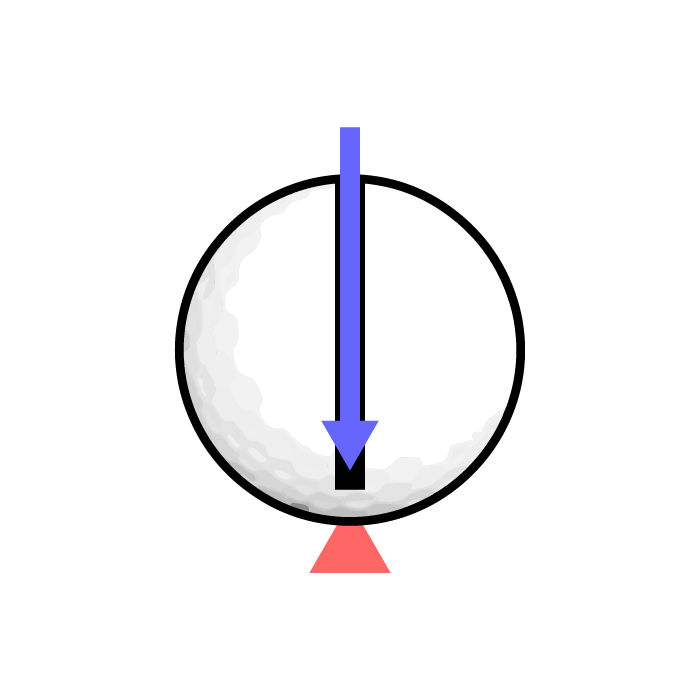
The line of compression is very simply the direction in which you are applying force through the ball. You may be wondering how the line of compression can be a straight line when the clubhead moves in an arc through the impact interval? The answer lies in how the ball and clubhead interact.
During impact, the ball and clubface “stick” to each other as the ball is pushed along the clubhead’s arc of travel. So long as the impact point — the point on the ball where the clubface first makes contact — remains in contact with the clubface, and the force from the club remains through that impact point, the line of compression will be a straight line relative to the ball itself.
So from an external perspective, the line of compression appears to be an arc, but to the ball it’s a straight line.(5) In each of this topic’s diagrams, the line of compression’s direction is shown at separation. Depending on the hinge action employed, the line of compression will be pointing in a different direction at impact.
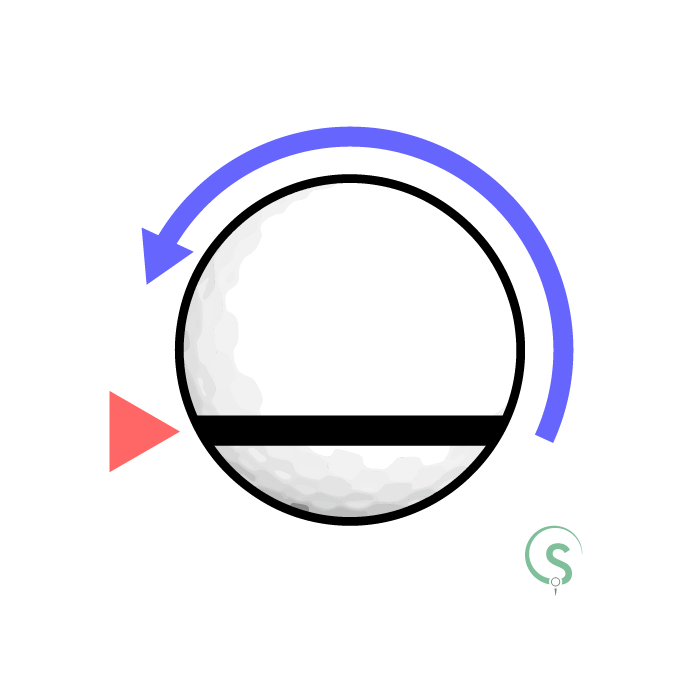
We’ve discussed what happens when the line of compression passes through the centre of the ball. In reality, this doesn’t happen, except potentially when using a putter. Because all other clubs are lofted, leaning backwards, the clubface will first come into contact below the ball’s equator. The more loft a club has, the further the clubface leans back, the lower on the ball this impact point is.(6) This means our line of compression no longer passes though the centre of the ball, but below it. It’s this off centre force that produces spin on the ball. The direction of the spin will be backwards because the line of compression is below the equator. In order to produce a forward spin, topspin, the line of compression would have to be above the ball’s equator. This is otherwise known as a topped shot, where the bladed edge of the club hits the ball above its equator. The further from the centre of the ball the line of compression is, the more spin will be imparted on it. That is to say a 3 iron, with its impact point relatively close to the ball’s equator will impart less backspin on the ball than a 60 degree wedge, with its relatively low impact point. It’s this difference in impact point location, the higher and lower lines of compression, which affect the amount of backspin, not so much the ball rolling off a lofted club.(7) It’s this amount of backspin which affects how high the ball flies.
Steps Five & Six